Quick answer
Match the zone first, then qualify the fixture
Subcontractor workflow: build a zone matrix, close an evidence matrix and approve a measured night mock-up before bulk supply.
For a Saudi Red Sea coastal project, do not begin with wattage or an IP label. Freeze the lighting zone, ecological constraint, exposure class, visual target, controls and maintenance route first. Then shortlist fixtures whose optics, enclosure, coating system, fasteners, cable entry, driver protection and test evidence satisfy that exact package. A model that works at a hotel entrance may be unsuitable only a few metres away at a beach edge.
Independence notice: this is an educational procurement guide for subcontractors. Topeng Global does not claim to be an approved vendor, partner or supplier to NEOM or Red Sea Global. The employer's specification, issued drawings, environmental requirements and approved-vendor process always take precedence.
Why Red Sea projects change fixture matching
Saudi Arabia's Red Sea developments combine salt-laden air, heat, ultraviolet exposure, wind-blown dust, irrigation, high-quality hospitality finishes and ecologically sensitive shorelines. NEOM describes extensive coastline and marine habitats under active conservation, while Red Sea Global has published a lighting strategy intended to support safe movement and protect the nocturnal environment. Fixture matching is therefore a coordinated engineering exercise, not a catalogue filter.
Ingress protection, corrosion resistance and responsible light distribution are three separate checks. IEC 60529 classifies enclosure protection against access, dust and water. It does not, by itself, prove resistance to salt corrosion, suitability for a cleaning regime or compliance with environmental lighting limits.
1. Freeze six controls before comparing models
- Zone: beach edge, boardwalk, landscape path, guest terrace, facade, service road, jetty or water feature.
- Exposure: distance from breaking surf, direct spray, salt deposition, washdown, irrigation, standing water, sand and ambient temperature.
- Environmental limit: permitted CCT, spectral restriction, upward-light allowance, curfew, dimming profile and wildlife buffer.
- Visual task: orientation, step recognition, facial recognition, architectural accent or maintenance access.
- Electrical system: voltage, earthing class, surge strategy, remote-driver location, protocol and emergency requirement.
- Maintenance plan: access, cleaning, replaceable parts, isolation point, spare ratio and target design life.
If an input is unknown, issue an RFI rather than converting an assumption into a purchase order.
2. Match fixture families by project zone
| Project zone | Useful fixture family | Optical priority | Evidence to request |
|---|---|---|---|
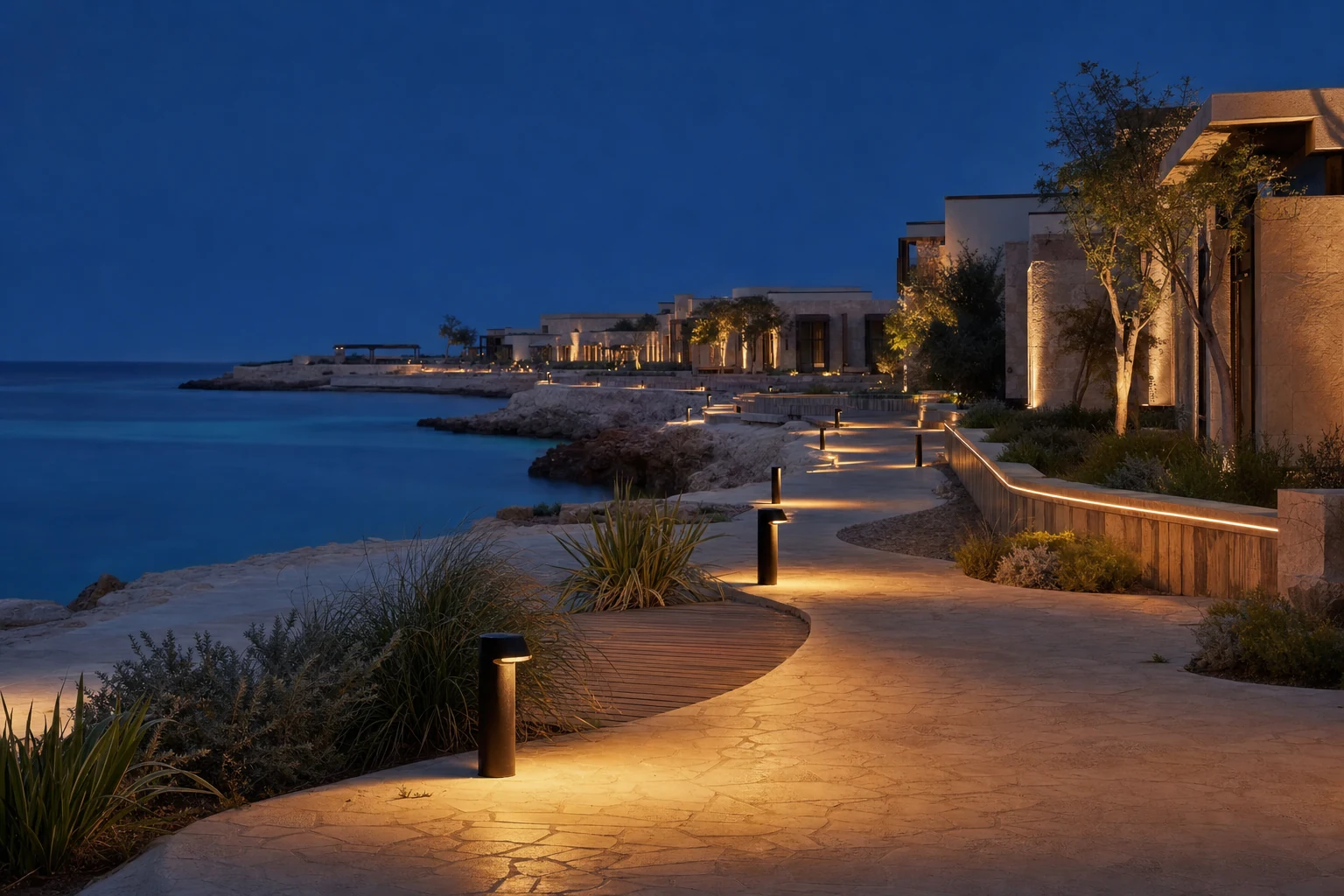
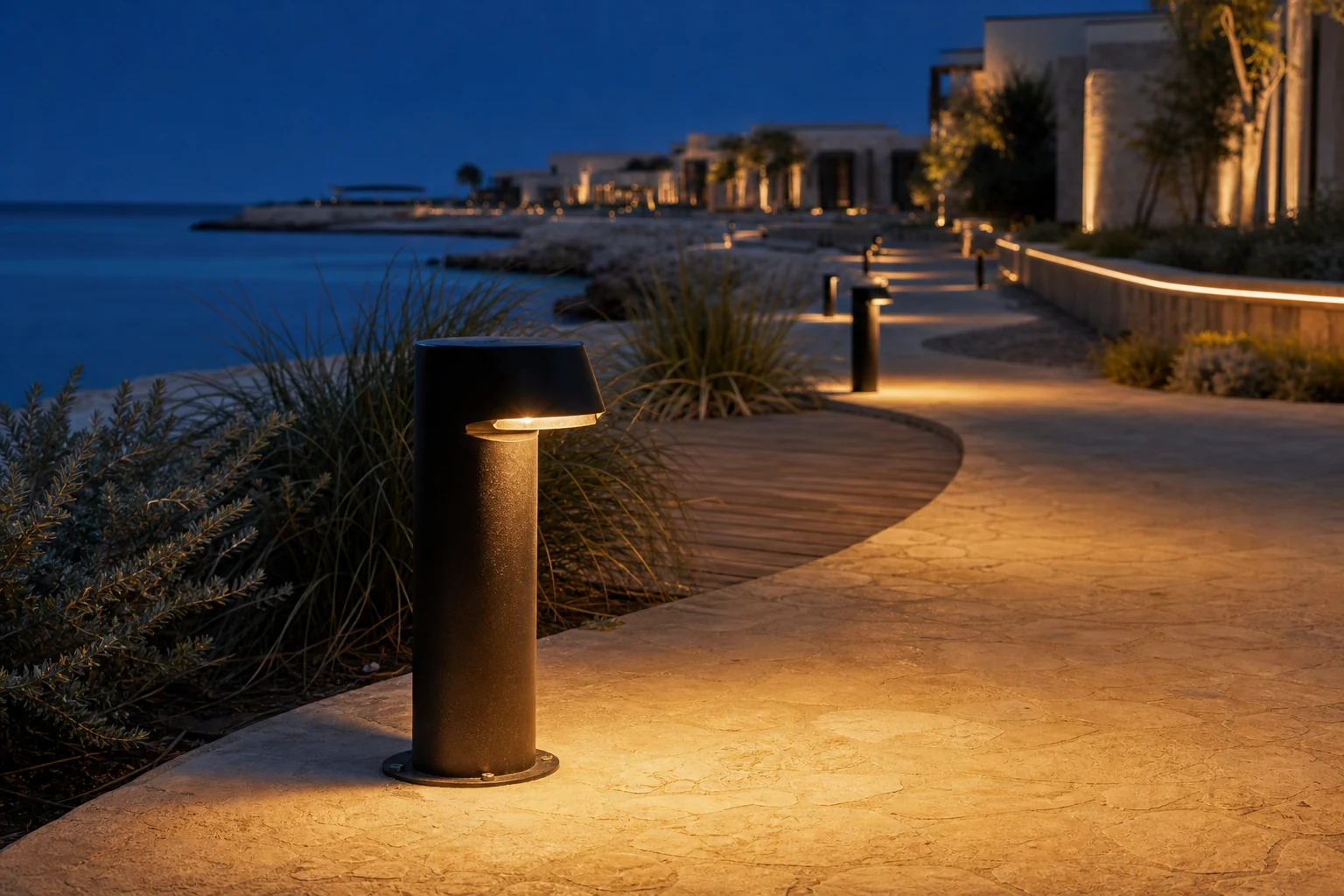
| Beach-edge path or boardwalk | Shielded bollard, low-level step light or concealed marker | Full cut-off, low mounting height, warm approved spectrum and no spill toward habitat | IES/LDT, shielding drawing, CCT or spectral report, coating and salt-test declaration |
| Resort landscape and arrival path | Shielded bollard, recessed step light or narrow landscape accent | Low glare from guest viewpoints, controlled contrast and serviceable optics | Aiming schedule, mock-up sample and material/finish sample |
| Hotel facade away from a sensitive boundary | Wall washer or linear facade light | Precise beam control and minimal upward or seaward spill | Facade calculation, aiming detail, IES file and controls schedule |
| Service road or back-of-house | Road or area luminaire with asymmetric optic | Task visibility without overlighting adjacent habitat | Road calculation, surge data, thermal limits, cut-off data and maintenance plan |
| Jetty, splash zone or water feature | Purpose-designed marine or underwater assembly only where permitted | Electrical safety, sealing and service isolation before decorative effect | Exact exposure declaration, material compatibility, cable/gland specification, test reports and method statement |
3. Treat IP and corrosion as separate submittals
Ask the supplier to identify the complete corrosion system: base alloy, pretreatment, coating chemistry and thickness, cut-edge protection, stainless grade for exposed fasteners, isolation between dissimilar metals, gasket material, cable gland, pressure-management method and repair procedure. A generic phrase such as “marine grade” is not enough.
For salt testing, request the named method, severity, duration, specimen construction, pass/fail criteria and laboratory report. IEC 60068-2-52 covers cyclic salt-mist testing for equipment intended for salt-laden atmospheres. ISO 9227 defines salt-spray methods but cautions that the test does not predict long-term service life or provide a universal ranking between materials. Use the report as evidence within the project specification, not as a lifetime guarantee.
Submittal red flag
“IP66, therefore corrosion-proof” is not an acceptable conclusion. Review the IP report, corrosion declaration and exposure assessment as separate documents.
4. Build dark-sky and ecology requirements into the optic
Red Sea Global has publicly described measures to reduce light pollution and protect nocturnal wildlife, including sea turtles. DarkSky International and the Illuminating Engineering Society summarize responsible outdoor lighting as useful, targeted, low level, controlled and warm-coloured. Convert those principles into measurable deliverables:
- Use light only for an agreed task and remove decorative spill with no project function.
- Select shielding and optics that keep light on the target and out of the sky, sea and sensitive boundary.
- Specify the lowest approved output, then provide scheduled dimming and curfew scenes.
- Use the warmest spectrum and CCT accepted by the environmental and lighting consultants; do not assume one CCT applies to every zone.
- Submit photometric files and calculations for horizontal, vertical and boundary conditions, not only a lumen value.
5. Coordinate protection, controls and maintenance
Coastal failures often occur at interfaces rather than the LED board. Confirm driver ambient rating, surge coordination, cable type, gland size, loop arrangement, junction-box location, earthing, condensation management and access for isolation. Keep remote drivers and control gear out of the harshest exposure where the design allows.
For DALI, 0-10 V, DMX or a project-specific system, submit the addressing method, default scene after power recovery, failure state, astronomical-clock logic, curfew profile and commissioning responsibility. The controls narrative must match the fixture schedule and lighting-management plan.
6. Use an evidence matrix, not a brochure stack
| Decision | Minimum evidence | Reviewer question |
|---|---|---|
| Optical fit | IES/LDT, optic code, output and calculation | Does the offered optic reproduce the approved scene and boundary limits? |
| Environmental fit | IP report, material schedule, coating data and specified salt-test report | Does the tested construction match the offered construction? |
| Thermal/electrical fit | Ambient range, driver data, surge and wiring diagram | Are ratings valid at project voltage and local ambient? |
| Finish fit | Physical colour/texture sample and repair method | Will batch finish and site repair meet the architectural standard? |
| Maintenance fit | Exploded view, replacement list, access and warranty terms | Can the asset team isolate, clean and repair the unit safely? |
7. Approve the night mock-up before bulk supply
Build the mock-up with the offered fixture, optic, finish, driver, cable and control gear. Measure the task surface, vertical viewing direction and sensitive boundary. Photograph fixed camera positions, record dimming values and lock the approved aiming angle. The signed record should identify model, optic, CCT, output setting, mounting detail and control scene.
A beautiful close-up photograph is not an approval record. The mock-up must demonstrate the complete system under representative site conditions.
8. Topeng catalogue starting points
These models are discussion starting points, not an approved product list. Final selection requires project drawings, environmental limits and confirmation of the exact offered construction and test scope.
YY-DMD-C316 inground light
A 316 stainless-steel catalogue option for landscape or walkway details. Confirm load, drainage, glare, cable entry and coastal tests.
YY-BDD-001 bollard
A low-level path form to compare for shield, optic, output, finish and controls. Do not infer dark-sky approval from form alone.
YY-XQD-3828 wall washer
A facade starting point where the approved zone permits architectural light. Confirm aiming, spill, coating and control scene.
YY-XTD-2037 linear light
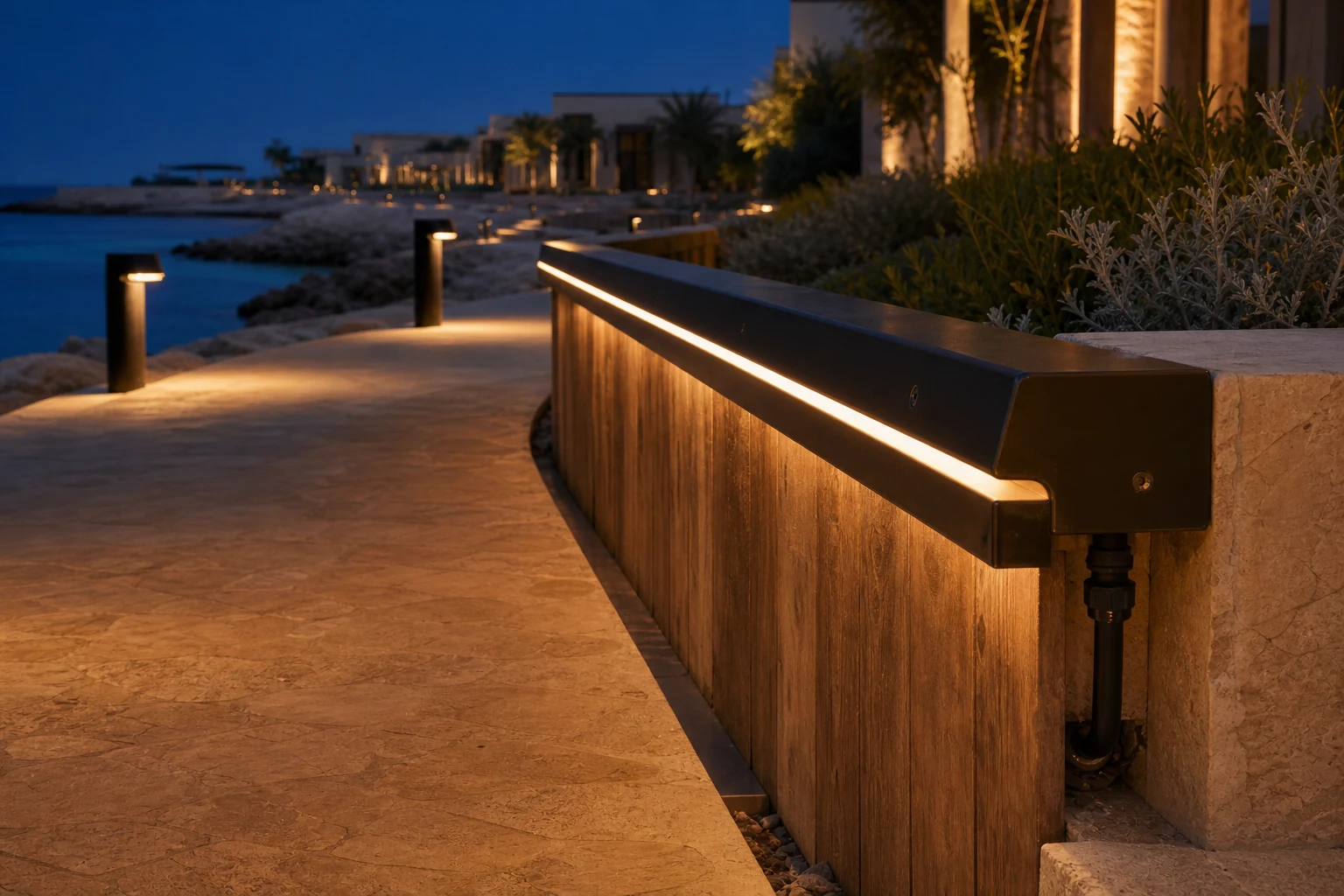
A concealed linear option for grooves or edges. Review drainage, access, continuity, optics and replacement method.
YY-SDD-S304 underwater light
A water-feature option only. IP68 does not establish seawater suitability; request an explicit application and material declaration.
9. RFQ package for a useful first quotation
- Project country, city, package name and zone-by-zone fixture schedule.
- Plans, sections, mounting details, control narrative and approved lighting criteria.
- Ambient temperature, salt/spray exposure, cleaning, irrigation and sensitive-boundary notes.
- Voltage, CCT or spectral limits, optic, finish, output, protocol and quantity.
- Required reports: IP, IK where applicable, photometry, corrosion method, material declaration, electrical safety and certificates within scope.
- Sample, mock-up, packing, spare, warranty, lead-time and inspection requirements.
10. Release procurement through five gates
Gate 1, prequalification: confirm that the manufacturer can disclose the offered construction and provide traceable evidence. Gate 2, sample: inspect material, finish, sealing interfaces, cable entry and service access. Gate 3, technical approval: close every compliance comment and RFI against one revision of the schedule. Gate 4, night mock-up: approve the optic, aiming, dimming and environmental boundary using the offered hardware. Gate 5, batch control: link the purchase order, inspection plan, packing list and delivery labels to the approved model, optic, CCT, finish and driver.
Do not release the full quantity because a visual sample looks acceptable. Procurement should advance only when the document set, physical sample and measured scene describe the same product configuration. Record approved substitutions as new technical decisions rather than informal commercial equivalents.
Primary references
- NEOM: Our Nature
- NEOM: Islands of NEOM and the Red Sea marine ecosystem
- Red Sea Global: Mitigating the threats of light pollution
- DarkSky: Five Principles for Responsible Outdoor Lighting
- IEC 60529: Degrees of protection provided by enclosures
- IEC 60068-2-52: Cyclic salt mist testing
- ISO 9227:2022: Salt spray tests
References checked on 13 July 2026. Project specifications and current authority requirements remain controlling.