Quick answer
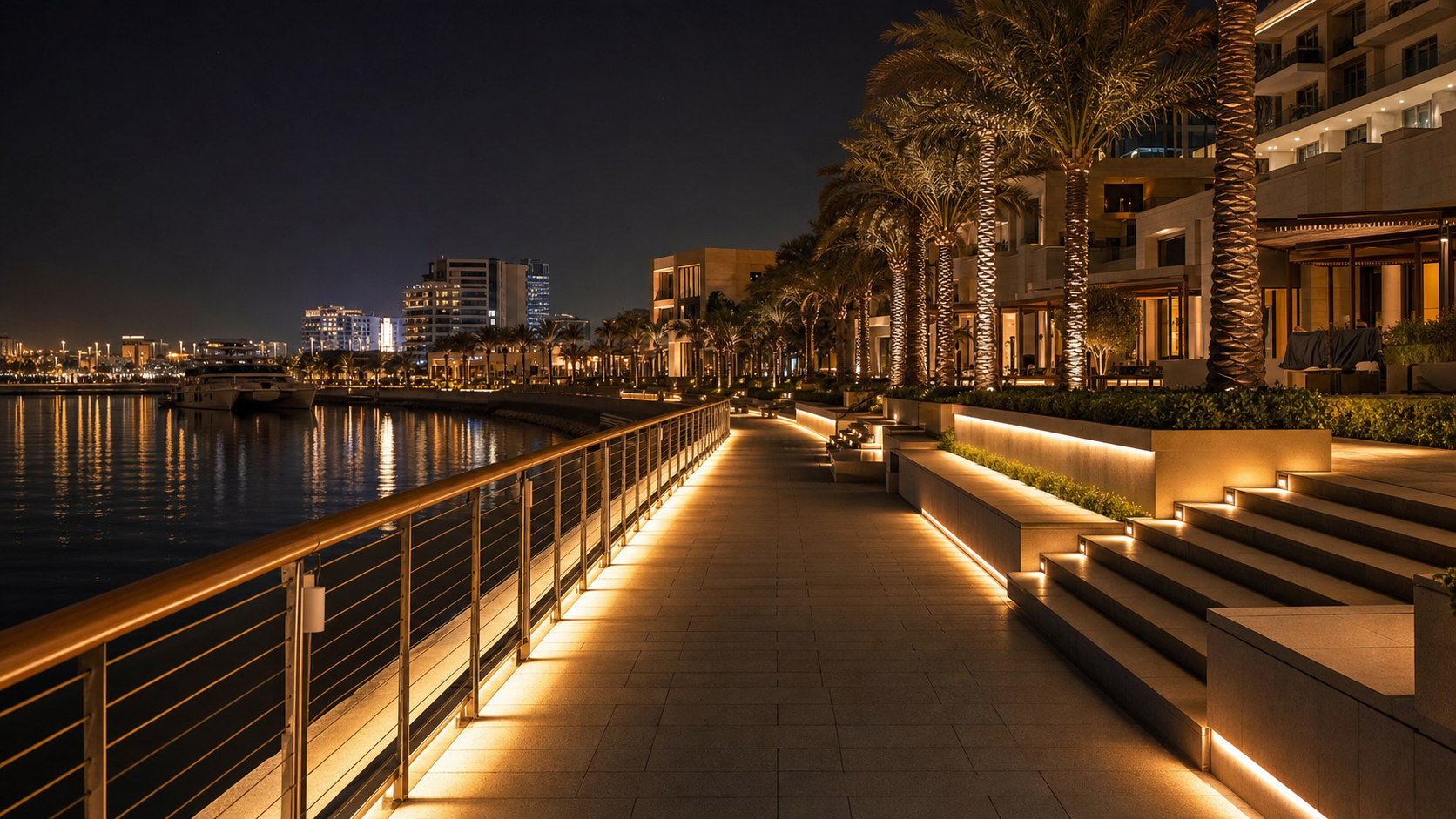
Waterfront lighting design should create safe, comfortable and attractive nighttime spaces without exposing visitors to harsh glare. For Middle East promenades, marina edges, riverside parks and hotel waterfronts, the best approach is warm white, low-glare, concealed outdoor LED lighting with durable IP-rated fixtures.
How to plan safe, comfortable and premium waterfront lighting
This video guide explains low-glare waterfront lighting, warm white atmosphere, concealed installation and product selection for Middle East public spaces.
Waterfront lighting is more than decoration
Waterfront promenades, riverside parks, lakeside walkways and marina projects have become important public spaces across the Middle East. A good lighting system improves safety, comfort, visitor flow and the overall night experience.
The goal is not simply to make the area brighter. Successful waterfront lighting balances functionality, atmosphere and long-term reliability.
Safety comes first: reduce glare for pedestrians
Visitors spend more time walking, resting and enjoying the water view in waterfront areas than in many other outdoor scenes. Excessive brightness or visible light sources can create discomfort and reduce the perceived quality of the space.
Instead of exposing the fixture directly, designers should use concealed lighting techniques. The visitor should see the light effect, not the hardware. This creates a softer atmosphere while keeping enough visibility for safe walking.
Choose warm white lighting for natural night views
Unless a project requires a dedicated light show or entertainment display, warm white lighting from 2700K to 3000K is usually the preferred choice for waterfront environments.
Warm white lighting supports a relaxed mood, highlights landscape features naturally and works well with water reflections. It is suitable for hotels, public parks, residential waterfronts, marina walkways and commercial outdoor spaces.
Select the right fixture for each application
| Application | Suggested product | Why it works |
|---|---|---|
| Handrails and retaining walls | Concealed linear LED lights | Continuous low-glare guidance along the walkway edge. |
| Stairs and level changes | Anti-glare step lights | Improves safety while staying visually quiet during daytime. |
| Trees and sculptures | Small landscape spotlights | Adds soft accents without flooding the whole scene. |
| Nearby buildings | LED wall washer lights | Highlights facade rhythm when the beam is controlled away from pedestrians. |
| Landmark bridges or tourism zones | DMX512 RGB/RGBW systems | Supports dynamic scenes when the project requires entertainment lighting. |
Hidden lighting creates premium visual effects
One principle of high-end waterfront lighting is simple: see the light, not the fixture. Recessed or concealed installations keep the hardware hidden while illuminated surfaces, pathways and water reflections become the visual focus.
This approach gives public spaces a cleaner architectural appearance and makes hotels, parks and marina projects feel more premium at night.
Consider the Middle East environment
Outdoor lighting projects in Saudi Arabia, the UAE, Qatar, Oman, Kuwait, Bahrain and Iraq must handle high temperatures, sand, dust, coastal humidity and long operating hours.
- Use IP65/IP66 for exposed outdoor positions and IP67/IP68 where water, irrigation or splash exposure is possible.
- Prioritize corrosion-resistant materials, sealed connectors and suitable surface treatment for coastal sites.
- Confirm heat dissipation and maintenance access before final model selection.
- Use beam control and glare shielding for pedestrian comfort.
Planning checklist before quotation
Send these details for a faster RFQ:
- Project country and waterfront type: promenade, marina, riverwalk, hotel, public park or commercial zone.
- Walking distance, pathway width, stair locations and handrail or wall details.
- Target CCT, glare-control expectation and whether the site needs static or dynamic lighting.
- Mounting height, beam angle expectation, water exposure and maintenance route.
- Required documents: datasheet, IES file, certificate preview, packing plan and OEM/ODM needs.
How Topeng supports waterfront lighting projects
Topeng supports Middle East waterfront developments with product selection recommendations, lighting solution discussion, OEM and ODM customization, technical documentation, IES files, product datasheets, export packaging and project quotation support.
Whether your project is a public park, marina, riverside promenade, hotel waterfront or commercial development, Topeng can help identify suitable outdoor lighting product families before quotation.
Recommended products for waterfront lighting
- LED linear lights
- Anti-glare step lights
- LED wall washer lights
- Landscape spotlights
- In-ground lights
- Bollard lights
- Underwater lights
- DMX512 RGB architectural lighting
FAQ
- What color temperature is best for waterfront lighting? Warm white 2700K to 3000K is usually best for comfortable public spaces, hotels and landscape waterfronts.
- How can glare be reduced along waterfront walkways? Use concealed linear lights, shielded step lights, lower mounting brightness and controlled beam angles instead of exposed direct fixtures.
- Which IP rating should be used near water? Use IP65/IP66 for general outdoor areas, IP67 where splash or irrigation may occur and IP68 for underwater or submerged fixtures.
- Can waterfront lighting use dynamic RGB effects? Yes, but dynamic DMX scenes are best reserved for landmark bridges, tourism zones and programmed light shows.
Conclusion
A successful waterfront lighting project starts with planning, not only product selection. Low glare, warm white atmosphere, concealed installation, climate-ready fixtures and clear RFQ details help create safer and more attractive night spaces across Middle East waterfront projects.